Review 03 · live relays
Clinicians — verdict: narrow
The freshest directory of the three by a distance, with a telephone number on every single row — and the only one of the three you cannot send anybody a link to. Asked for Berlin, it answered with 135 Americans.
Clinicians is one route inside Rx.Luxury, a personal clinical desk that runs in the browser. Two things up front, because they bear on what this review is. The desk is not a medical device and gives no advice; its door says so before it lets you in. And its imaging lab, four items down the same rail, is a viewer — it reads a DICOM file and lets you window and page through it. It does not interpret an image, detect a finding or produce a report, and nothing here should be read as suggesting it does.
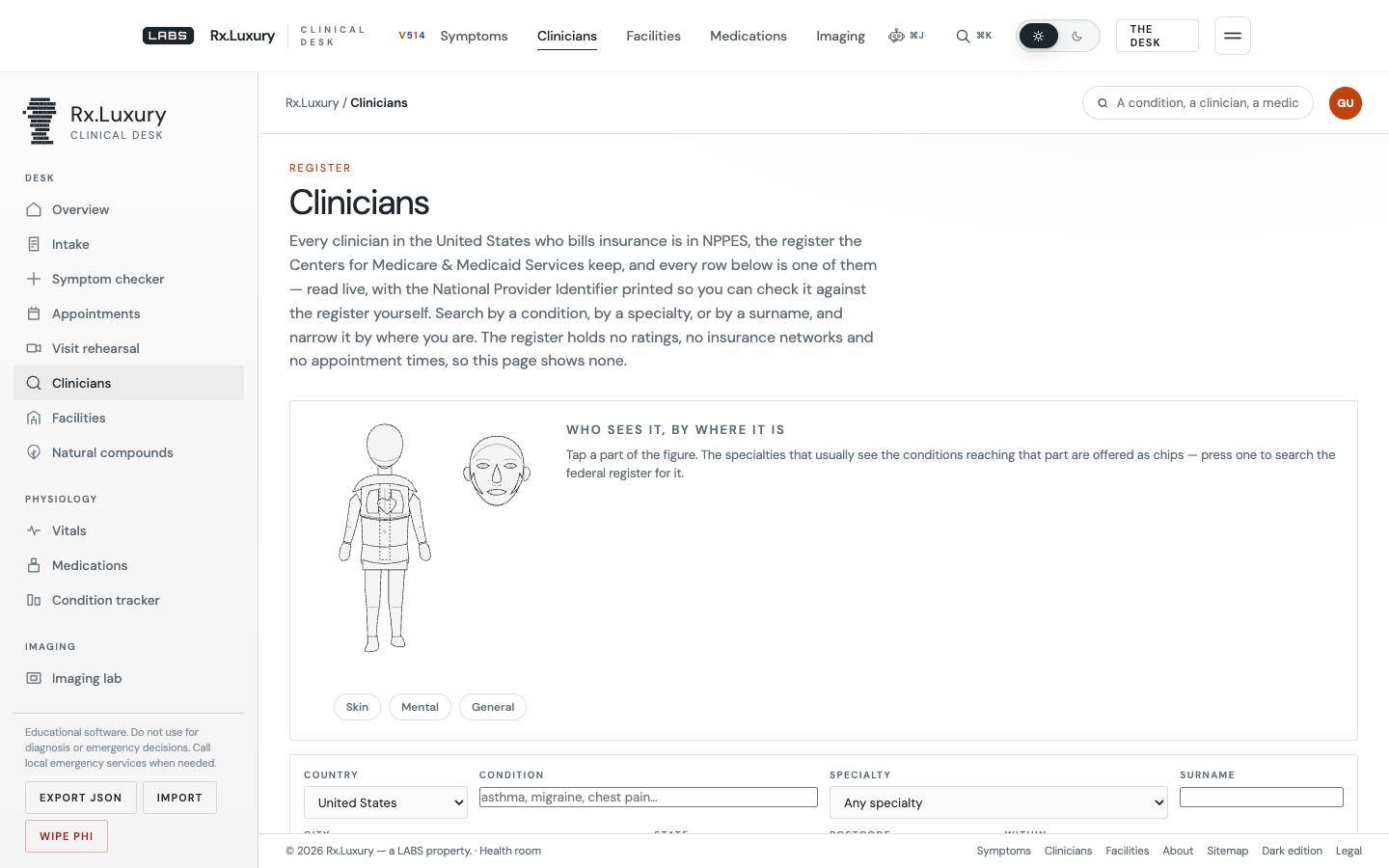
Clinicians itself is simpler than either of those: it is a search box over NPPES, the National Provider Identifier registry kept by the Centers for Medicare & Medicaid Services. The page describes itself better than a reviewer could:
"Every clinician in the United States who bills insurance is in NPPES, the register the Centers for Medicare & Medicaid Services keep, and every row below is one of them — read live, with the National Provider Identifier printed so you can check it against the register yourself. […] The register holds no ratings, no insurance networks and no appointment times, so this page shows none."
— the standfirst on labs.llc/rxluxury/#clinicians
That last sentence is the best line on any of the three properties this desk reviewed. A health directory that declines to invent a star rating is refusing the easiest traffic in the category.
labs.llc/rxluxury/ here, whatever you
search for.What it does well, measured
The relay is real. At 22:35 UTC this desk asked it for Anchorage, Alaska. It returned HTTP 200 in 42,022 bytes, 0.881 s to first byte, 189 rows, and it reported that it had discarded a further 11 rows as out of area. Every single one of those 189 rows carried a telephone number. Set that against the Dentist register's own Anchorage page, which prints 14% with a phone in its masthead, and the difference in record quality is not marginal — it is the difference between a map and a filing cabinet.
It also refuses well. Asked for the whole state with no narrowing term, it answered in 0.247 s with HTTP 400 and a sentence rather than a spinner: "The federal register will not answer a whole state at once. Add a city, a surname, a ZIP code or a specialty." That is an upstream limit translated into something a person can act on; most front ends would have swallowed it and shown an empty list.
And it is honest about what NPPES actually is. The Anchorage answer's commonest specialties were Counselor, Mental Health (21), Case Manager / Care Coordinator (12), Massage Therapist (9), Counselor, Addiction (9) and Registered Nurse (8). This is a register of everyone who bills insurance, not a physician list — which is why naming the page "Clinicians" rather than "Doctors" is the correct call.
The shortcoming
Published shortcoming
At 22:35 UTC this desk asked Clinicians for Berlin. It returned 135 rows. Every one of them was in the United States: Maryland 49, Vermont 28, Connecticut 16, New Jersey 15, New Hampshire 15, Wisconsin 5, Massachusetts 3, Ohio 3, Pennsylvania 1. Not one in Germany. Seventy-eight seconds earlier, in the same estate and from the same room, RX reported 1,705 practices in Berlin, Germany. The two products sit one click apart on labs.llc's health index and a reader has no way to know which of them speaks their country until they have already searched.
The second lost row follows from the first. Clinicians has no address of its own. It is
#clinicians on labs.llc/rxluxury/, behind a one-field door, and no search you run
changes what is in the address bar. You cannot bookmark a result, cite one, or send a parent a link to the
four geriatricians you found in their town. Dentist declares 3,955 crawlable pages and RX declares 4,201;
Clinicians declares none, because it has none to declare. The desk's own description of itself —
"The clinician directory is the federal NPI Registry, read live" — names neither the country nor
the limitation, and it is the only description most people will ever see.
One small thing, but it is the kind this desk notices. The first row of the Anchorage answer was a
provider whose name came back as Paul "worrell — a stray quotation mark in the federal record,
title-cased and printed straight through. The relay goes to real trouble over names elsewhere — its shipped
source carries a documented fix so that the register's all-capitals O'BRIEN does not come out as
O'brien, and hyphenated surnames survive the same way. A property that prints the
NPI precisely so you can verify a row should not print a quotation mark inside a surname while doing it.
The verdict
Narrow — 17 out of 30. Judged as what it is — a live lookup into one country's provider register, built into a personal desk — Clinicians is the most truthful of the three properties reviewed here. It reads the source rather than a snapshot, prints the identifier so you can audit any row, refuses queries it cannot answer, and declines to manufacture the ratings and availability every commercial competitor invents. It scores 17 because this desk scores directories, and on two criteria a directory that knows one country and produces no URLs has nothing to put in the box.
The remedy is not more data. It is a page. Give the search its own address outside the gate, let a city and a specialty live in the path, and the same relay would be competing with its siblings rather than sitting below them.